TruTravels: How UX Problems Become SEO Problems Become Ad-Cost Problems
How a sister brand's ad-performance crisis turned out to be a quiet 30% collapse in organic — and the destination-page rebuild that reversed it.
At a glance
- Role
- SEO consultant, brought in from G Adventures
- Client
- TruTravels (small-group tours, UK)
- Problem
- Organic down 30% YoY, hidden behind a paid "crisis"
- Fix
- Destination-page redesign
- Result
- −30% → +70% organic YoY, organic share 20% → 33%
Flown in to assist the paid team
TruTravels, a sister brand to G Adventures, came to us convinced they had a paid problem. Ad performance was slipping, costs were creeping up, and everyone was sure the fix lived somewhere in the ad accounts. I was brought in from G Adventures as a consultant to confirm it — and flown out to London to sit down with their team.
However I actually confirmed the opposite. Within a day of getting under the hood, it was clear the ads weren't the problem; they were a symptom.
Two dashboards, two different stories
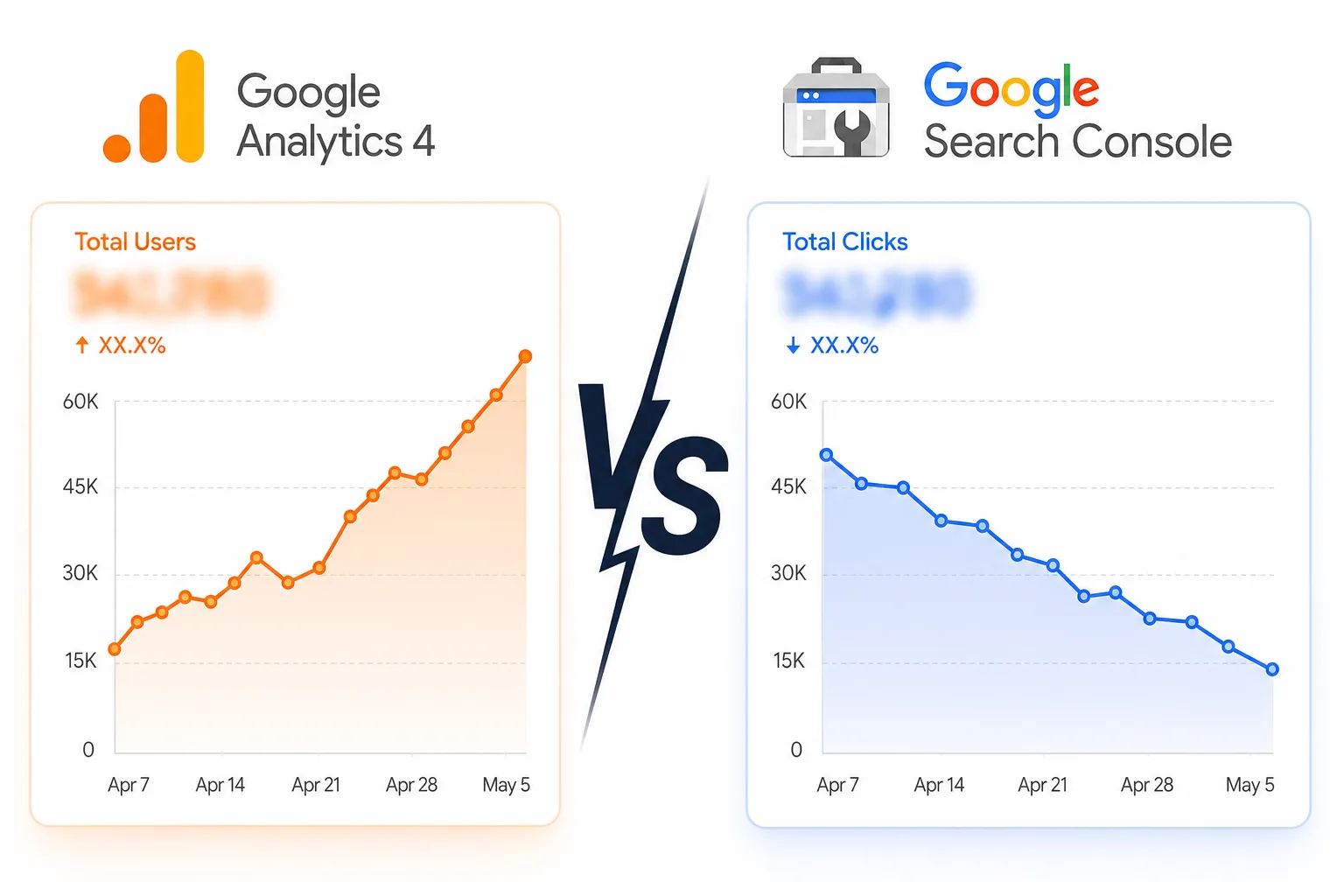
The first thing that caught my eye was that TruTravels' two analytics tools flatly disagreed. GA4 said organic traffic was healthy — up, even. Google Search Console said organic was down 30% year over year.
That contradiction wasn't noise. It was the whole case.
The reason they disagreed: GA4 was quietly counting traffic from a separate sister property alongside the main site, and that second site's growth was masking the main site's decline. So before I fixed anything, I made a measurement correction — I told the team to treat Search Console as the source of truth for organic until the analytics setup was cleaned up. You can't fix a problem you can't see clearly, and they'd been flying on a contaminated instrument.
The real number was ugly. Organic was down 30% YoY — and it had been quietly inflating their ad costs the entire time.
How poor SEO wrecks your paid strategy
The hidden tax bad SEO puts on your paid budget.
Here's the part most people miss: weak organic doesn't just cost you organic. It quietly makes your paid media more expensive, too.
Quality Score is the bridge
When your landing pages stop looking relevant to a query, Google lowers their Quality Score — its rating of how useful your page and ad are to the searcher. And Quality Score isn't a vanity metric; it feeds directly into what you pay and whether you show up at all.
Same problem, two penalties
A low Quality Score bills you twice. Your cost-per-click goes up — Google charges you more for the same click. And your Ad Rank goes down — so you win fewer auctions and show less often, even against competitors bidding the same amount. One relevance problem, two separate leaks, both draining the same budget. That's the tax.
What the documentation shows
This isn't marketing folklore — it's how Google's own auction is documented to work. Google's Quality Score guidance lists landing page experience — how relevant and useful your page is to the searcher — as one of the three things it grades, alongside expected click-through rate and ad relevance. That grade feeds Ad Rank, which sets both your position and the price you actually pay: for the same bid, the more relevant advertiser wins the better slot for less. Industry analyses put numbers on the swing — a top Quality Score can roughly halve cost-per-click versus an average one (WordStream), while a poor score multiplies it.
So when TruTravels' organic relevance eroded, their paid team wasn't losing auctions because they were bidding wrong. They were losing because the foundation underneath the whole account had gone soft.
This is the real reason SEO exists — to sell higher quality ads for Google.
Why the destination pages?
Destination pages are a travel site's category pages — a "Morocco" page that lists every Morocco trip. They matter more than any single trip page, because they're where search intent actually lives. Almost nobody types "discover a Moroccan desert journey" into Google. They type "Morocco trips" — and that query wants a page that lays out the options. Get those category pages right and you capture demand at the exact moment someone is deciding where to go.
TruTravels' destination pages weren't capturing it.
Hypothesis: the destination pages weren't converting because travellers didn't trust them
I knew what good looked like here — my team at G Adventures was in the middle of redesigning our own destination pages, so I had a stack of fresh research to measure against.
Put TruTravels' pages next to their competitors' and one thing jumped out: they looked different, and not in a good way. Where competitors led with a clear, familiar layout, TruTravels led with a large photo gallery and a prominent "upcoming departures" panel — choices that felt designed rather than data-backed. For their audience, that mattered. Many of TruTravels' customers are young people booking their first trip abroad, and for a first-time buyer, unfamiliar reads as untrustworthy. If a page doesn't look like what they expect a travel site to look like, a quiet alarm goes off: can I trust these people with my money and my holiday?
UX is a ranking signal: confirmed in Google's 2024 leak
Why a page that feels untrustworthy loses rankings, not just bookings.
It's tempting to file "the page feels untrustworthy" under conversion — a bookings problem, not a rankings problem. That used to be a defensible assumption. It isn't anymore.
What the 2024 leak showed
In 2024, roughly 2,500 pages of Google's internal Search documentation were accidentally published online, and Google confirmed they were real. Among the revelations was a system called NavBoost that re-ranks results based on how people actually behave — tracking whether a click was a "good click" or a "bad click," and how long someone stays before returning to the results.
Pogo-sticking is the signal you don't want to send
When a traveller clicks your page, feels that flicker of distrust, and bounces straight back to Google to pick a competitor, that round trip has a name — pogo-sticking — and it's exactly the kind of bad-click signal NavBoost is built to read. Enough of them and Google treats your page as the wrong answer, and ranks it lower.
One honest caveat: the leak confirmed Google tracks these signals; it didn't reveal how heavily they're weighted. It doesn't need to be the single biggest factor to be real and to point in one clear direction.
So fixing UX and fixing rankings were the same job
A destination page that makes a first-time traveller hesitate loses the booking and feeds Google a negative signal. Rebuild it to feel trustworthy and hold attention, and you win on both fronts at once — conversion and organic.
AI? Rankings still matter
The AI era runs on the SEO foundation, not around it.
It's fair to ask whether any of this survives the shift to AI search. It does — the foundation matters as much as ever, even as the tactics move.
AI answer engines don't conjure answers from thin air. They retrieve from the live web and from search indexes, then synthesize — which means the same fundamentals that decide whether a search engine can see and trust your page decide whether an AI can, too. A page an engine can't crawl, or doesn't trust, is a page it won't cite. (If that sounds familiar, it's the same crawlability-and-trust story that decides classic rankings.)
And the way these models judge what's authoritative is built on SEO's own vocabulary — clearly defined entities and the E-E-A-T signals of experience, expertise, authoritativeness and trust. The discipline is evolving fast, and how often ranking pages get cited is a moving target. But the raw material an AI reasons over is the one good SEO has been building all along.
How we redesigned it — without building anything
The recommendation to the business was deliberate: don't reinvent the page, rearrange it. I was confident we could fix this by reordering and strengthening components that already lived in the template — a low-effort, high-return path — rather than a costly ground-up build.
I set the SEO guardrails first: a simple need-to-have / nice-to-have / won't-miss template covering semantic markup, the components worth keeping and expanding, and where genuinely helpful content should live. Then — and I pushed hard for this — a qualified UX designer ran real user research on top of those guardrails, instead of anyone guessing.
The payoff is the part I care about most: her research independently reached the same conclusions I'd formed from the SEO and competitive side. The pages weren't building trust. The beloved "upcoming departures" panel wasn't the hero everyone assumed. And the unfamiliar layout was actively costing bookings. Two different methods, one answer — that's when you know you're right for the right reasons.
What the user research found
- Travellers are wary of booking with a company they've never heard of — trust has to be earned on the page itself, fast.
- The hero image gallery was quietly signalling the wrong customer. Travellers read the photos as "here's who travels with us," and drew conclusions that didn't match the actual audience.
- People wanted to grasp what a trip like this involves, quickly — and several components on the page were getting in the way of that rather than helping.
From there it was straightforward: align with the business on their wants and needs, confirm with the dev team that everything was genuinely low-effort as scoped, and ship. The rebuild lifted UX and conversion — and because we rebuilt the pages properly, we could finally load them with the helpful, relevant destination content that organic had been starving for.
The results
The redesign I led reversed the trend. TruTravels' organic went from down 30% year over year to up 70%, pulling in roughly 13,000 monthly clicks, and organic's share of total traffic climbed from 20% to 33% in five months — cutting their dependence on paid, and easing the tax on the ad budget along the way.
Most of that recovery matured after my engagement wrapped, on the foundation the rebuild put in place. That's the part I'm proudest of: the fix didn't need me standing over it. It held on its own.
What I took from it
Measure the right thing before you fix the wrong one. TruTravels nearly poured money into paid to solve a problem that lived in organic. The most valuable hour I spent there was the one that corrected which number to trust.
The best turnaround is usually rearranging what you already have. We didn't invent a new page. We put the right components in the right order, backed by research, and let the existing template do its job.
UX, SEO, and paid aren't three problems — they're one. Fix the page a user trusts, and rankings, conversions, and ad costs all move in your favour together.